Who Owns a Lead After the Intake Call?
Capturing caller context is only half the battle. If nobody is clearly assigned to act on the intake record, leads stall—here is how to establish explicit post-call ownership.
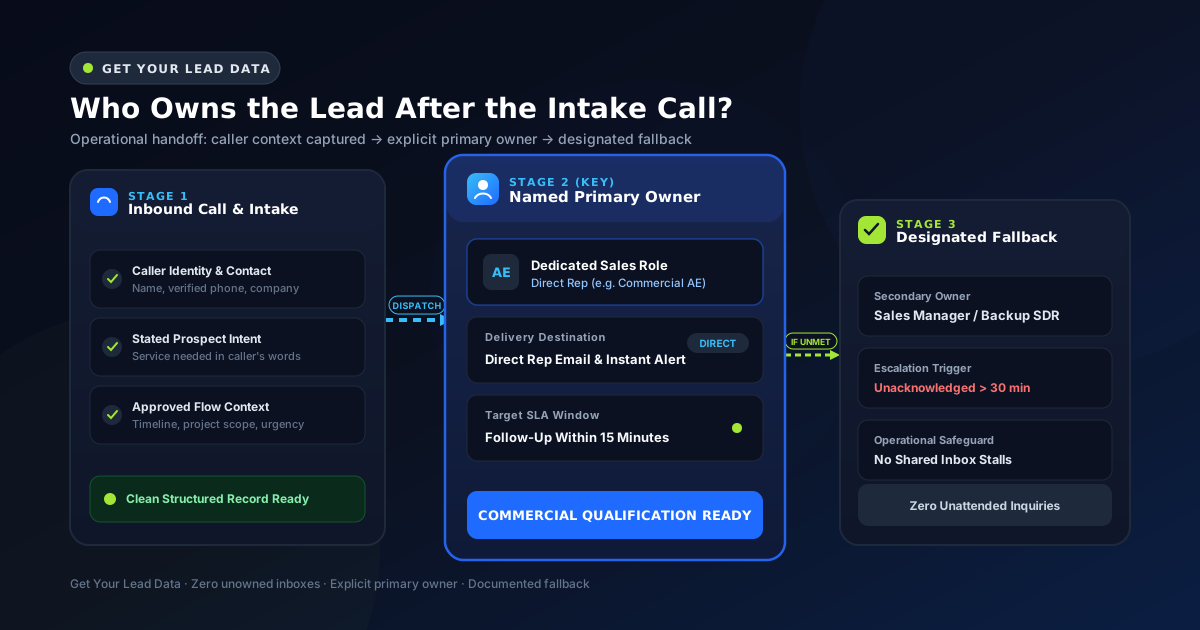
When an inbound call rings, your business has a brief window to turn an inquiring prospect into a paying customer. An inbound AI phone agent solves the first hurdle by answering 24/7, asking your approved intake questions, and structuring the caller's details into a clean record.
However, capturing the lead data is only the first half of the equation. The moment the caller hangs up, an equally critical operational question determines whether that opportunity converts:
Who owns the lead after the intake call?
In many small-to-midsize businesses, the answer is dangerously vague. The intake record lands in a shared email inbox, a generic notification channel, or an unmonitored spreadsheet. Everyone assumes someone else will follow up, or reps cherry-pick the simplest requests while high-value opportunities grow cold. When ownership is diffuse, nobody owns the outcome.
To build a reliable inbound sales motion, an SMB sales team must treat post-intake ownership as an explicit operational discipline. Deciding who owns the lead requires three core decisions:
- Naming the recipient before collecting caller details;
- Separating captured intake context from the salesperson's qualification decision; and
- Establishing explicit fallback ownership when the primary recipient is unavailable.
Here is how to structure post-intake lead ownership so every caller's information immediately moves toward a closed sale.
1. Name the recipient before collecting details
The most common mistake when designing an inbound call flow is starting with a laundry list of questions. Teams ask themselves: What information could we possibly collect from this caller? They assemble a lengthy questionnaire covering company size, software stack, budget brackets, and timeline expectations.
When the call concludes, the resulting record is bloated with trivia that nobody actually reviews.
To create an intake flow that drives revenue, invert the process: name the recipient before you write a single intake question.
Ask yourself:
- Which specific role or team member will receive this completed record? Is it a Senior Account Executive, an Inside Sales Representative, a Field Estimator, or an Operations Coordinator?
- What exact details does that person need to conduct an intelligent, personalized follow-up conversation?
- What format and delivery destination allow that person to review the context within minutes rather than hours?
When you identify the recipient first, your intake questions become lean and intentional. As discussed in our guide on what to ask on an inbound lead call, the best questions are those that create a productive next step without forcing the caller to repeat their story later.
If an Estimator needs to know the property address and the type of roof leak before quoting, the intake captures those specific points. If an Account Executive only needs the caller's name, callback number, and primary operational pain point, the intake stops there. Naming the owner upfront protects your prospect's time on the phone and ensures the receiving rep gets actionable data, not irrelevant noise.
2. Separate captured context from the sales qualification decision
A frequent point of friction in SMB sales operations is confusing intake data with a salesperson's qualification judgment.
An automated intake flow is designed to gather structured caller context:
- Caller identity and verified contact information: Name, phone number, company name, and preferred callback channel.
- Stated intent: Why the caller reached out in their own words.
- Basic parameters: Service category, project timeline, or urgency level.
What the intake flow cannot—and should not—do is make the final commercial qualification decision.
The role of intake: preparing the conversation
The intake agent provides objective context. It answers: Who is calling, what did they ask for, and what specific details did they share? It prepares the ground so your sales team has an unfair advantage when they pick up the phone.
The role of the salesperson: determining opportunity fit
The salesperson evaluates commercial viability. They answer: Does this customer fit our margin profile? Can our team fulfill their timeline? Is the budget realistic for our scope of work?
As emphasized in our lead-intake checklist for the next sales conversation, keeping the intake separate from the sales decision preserves operational agility. If an intake script attempts to act as a rigid gatekeeper, asking invasive qualification questions too early, high-intent callers hang up in frustration.
Instead, let your intake capture the essential facts, and entrust your sales reps with the commercial conversation. The intake delivers the context; the sales professional delivers the conversion.
3. Plan for recipient unavailability and fallback ownership
Even the most clearly defined ownership structure breaks down when life happens. Reps go on vacation, attend multi-hour client presentations, take sick leave, or field back-to-back phone calls.
If your lead flow relies solely on a single primary recipient with no backup mechanism, inbound inquiries will stall the moment that rep steps away from their desk.
To ensure uninterrupted lead velocity, every intake route must feature a documented fallback path:
Avoid the "shared inbox" black hole
Routing unassigned or overflow leads to a general company inbox (e.g., sales@ or info@) is where leads go to die. In a shared inbox, diffusion of responsibility takes over. Team members assume their peers have already claimed the message, leading to delayed outreach or embarrassing duplicate calls from competing reps.
Assign an explicit secondary owner
Every intake path should designate a named secondary owner—such as a Sales Manager, a Lead Dispatcher, or an On-Deck SDR. If the primary owner does not acknowledge or open the lead record within an agreed operational window (e.g., 15 or 30 minutes during business hours), the record is automatically flagged for the secondary owner to reassign or handle directly.
Separate live transfer fallbacks from record delivery
If your call flow includes a warm transfer rule for high-intent callers (connecting the prospect live to an available rep), you must define what happens if the rep does not answer. Rather than leaving the caller on infinite hold or dropping them into a generic voicemail box, the agent gracefully completes the intake, confirms the caller's details, explains that the specialist is currently assisting another client, and dispatches the completed record to both the primary and fallback owners for prompt callback.
As outlined in our guide on what to decide before you launch a lead-intake flow, deciding these exception paths before your line goes live keeps your customer experience polished and professional under any staffing condition.
4. Post-intake lead ownership worksheet
Use this operational worksheet to map out explicit ownership for each category of inbound call your business receives. Completing this table with your sales leadership ensures that every caller has a named destination and an agreed fallback before calls start coming in.
| Inbound Inquiry Category | Primary Post-Intake Owner | Delivery Destination / Format | Target Follow-Up Window | Secondary Fallback Owner | Escalation Trigger |
|---|---|---|---|---|---|
| e.g., Commercial Installation | Senior AE (John Doe) | Direct Email / Sales Notification | Within 15 minutes | Sales Manager (Jane Smith) | Unacknowledged after 30 min |
| Category 1: [Standard New Inquiry] | [Role / Specific Rep] | [Email / Slack / Endpoint] | [e.g., < 30 minutes] | [Backup Rep / Manager] | [Unopened after X minutes] |
| Category 2: [Urgent / High-Value Intent] | [Primary Specialist] | [Direct Mobile / Instant Alert] | [Immediate / Live Transfer] | [On-Call Team Lead] | [No answer on warm transfer] |
| Category 3: [Existing Account / Service] | [Account Manager] | [Support / AM Queue] | [e.g., Same business day] | [Operations Coordinator] | [Out of office / Unassigned] |
| Category 4: [General / Unclassified] | [Inbound Triage Rep] | [Triage Queue] | [Within 1 hour] | [Sales Director] | [Pending triage > 2 hours] |
Note: This worksheet is an illustrative operational planning aid for internal team alignment; it does not represent an automated CRM routing engine, automatic round-robin distribution, or guaranteed lead completeness.
5. An illustrative scenario: How an SMB service firm assigns post-intake lead owners
To see how an SMB sales team structures post-intake ownership in the real world, consider this operational example:
Illustrative Example
Apex Commercial Pest Management is a growing regional service firm with three Commercial Account Executives, two Residential Estimators, and an Operations Coordinator. After launching an inbound marketing campaign, inbound call volume doubled, but the closing rate dropped. Prospective commercial clients were complaining that nobody returned their calls until the following afternoon.
The Sales Director audited their inbound workflow and discovered the bottleneck: all phone intake summaries were feeding into a single shared inbox (
inquiries@apexcommercial.com). Because no single person was assigned to incoming records, the three Commercial AEs assumed someone else was handling them, while residential inquiries sat mixed in with high-value commercial accounts.The team restructured their post-intake ownership in three steps:
- Categorizing by caller intent upfront: The intake agent was configured with two qualifying initial questions to identify whether the caller represented a commercial facility (warehouses, restaurants, office parks) or a residential property.
- Naming explicit primary recipients: Commercial inquiries were routed directly to the Commercial AE on rotation, delivering the caller's facility type, square footage estimate, and pest issue directly to the rep's direct inbox. Residential calls were sent directly to the Residential Estimator queue.
- Establishing fallback accountability: The Operations Coordinator was named as the universal fallback owner. If a commercial inquiry was not logged as contacted within 45 minutes during business hours, the coordinator received an alert to reassign the record to the next available AE.
By establishing explicit ownership and a reliable fallback path, Apex eliminated unowned leads and ensured every caller's structured context received rapid follow-up.
This scenario is an illustrative operational example designed to show cross-team ownership mapping; it does not represent an actual customer endorsement, proprietary integration, or verified performance outcome.
6. How Get Your Lead Data turns inbound calls into owned lead records
At Get Your Lead Data, our mission is simple: provide a straightforward inbound AI phone agent that answers incoming calls, qualifies callers against your specific intake questions, and captures structured lead data for a sales next step—so you get the lead data instead of losing it to voicemail.
Straightforward setup and customer control
Getting started does not require an expensive consulting engagement or weeks of engineering:
- Sales-assisted initial setup: A sales agent works directly with you to establish your initial call flow, intake questions, and recipient handoff rules.
- Customer control in the platform: Once your initial flow is live, you can make ongoing adjustments directly in the platform as your sales team, schedules, or priorities change, with support available for additional assistance.
Transparent, predictable commercial terms
We believe business phone services should be transparent, accessible, and simple to understand:
- Standard subscription: The standard AI Phone Agent subscription is $199 per month, billed month to month.
- Zero upfront fees: There is no setup or onboarding fee ($0).
- Included monthly allowances: Each monthly billing period includes 500 inbound voice minutes and 500 SMS text messages.
- Affordable metered overages: Usage beyond monthly allowances is billed at $0.12 per additional minute and $0.02 per additional SMS.
- Month-to-month flexibility: Cancel before your current billing period ends to prevent renewal for the next cycle. Service continues through the paid period; overage charges already incurred remain due. Refunds for prepaid monthly service are considered case by case.
Put your lead data into the right hands today
Don't let captured caller context sit idle in an unowned inbox. Pair lean intake questions with clear human ownership to turn inbound calls into closed sales.
- Ready to map your inbound flow? Build your intake flow with our team or start phone service directly.
- Explore our process: Read How Get Your Lead Data Works and check our Lead Capture FAQ.
- Refine your intake questions: Review What to ask on an inbound lead call.
- Prepare your sales team: Read A lead-intake checklist for the next sales conversation.
- Plan your launch decisions: Review What to decide before you launch a lead-intake flow.
- Review our terms: Read the complete Get Your Lead Data Terms of Service.